Bugatti’s W16 Era Ends After Two Decades of Hypercar Excess
Bugatti has ended production of the quad-turbo W16, closing the chapter that defined the Veyron and Chiron and helped establish the modern hypercar.
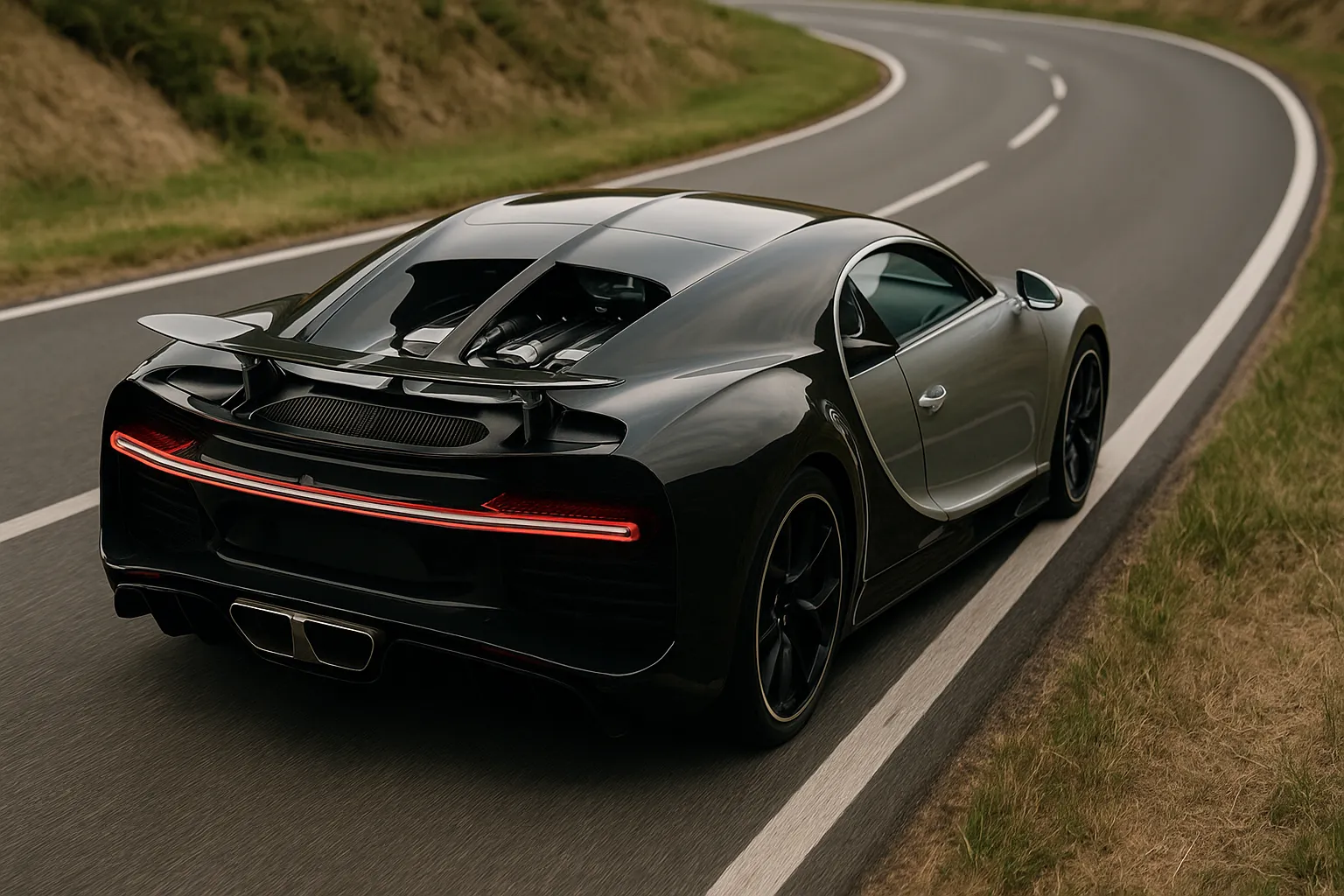
Bugatti’s 8.0-liter quad-turbocharged W16 has reached the end of production, closing one of the most unusual and influential engine programs in modern performance-car history. The engine powered the Veyron, Chiron and a run of ultra-limited Bugatti models that turned four-digit horsepower from an engineering curiosity into a defining feature of the hypercar class.
The end of the W16 is not just a mechanical footnote. For nearly 20 years, this engine was Bugatti’s identity: sixteen cylinders, four turbochargers, immense cooling needs, enormous torque and a level of speed that forced the industry to rethink tires, aerodynamics, transmissions and testing procedures. Its retirement marks the point where Bugatti’s modern Volkswagen Group-era engineering statement gives way to a new hybrid chapter.
From revival project to hypercar template
Bugatti’s modern era began after Volkswagen Group acquired the storied French marque in 1998. The brand’s early concept cars previewed an ambition that went far beyond building another exotic coupe. The eventual production car, the Veyron 16.4, arrived in the mid-2000s with a mission that sounded almost unreasonable at the time: more than 1,000 metric horsepower, luxury-car refinement and a top speed beyond 250 mph.
The W16 made that possible. Its layout effectively placed two narrow-angle V8 banks together on a common crankshaft, creating a compact sixteen-cylinder configuration compared with a conventional V16. Add four turbochargers and an elaborate cooling system, and the result was an 8.0-liter engine unlike anything else in a road car.
In original Veyron form, the W16 produced 1,001 metric horsepower, or 987 hp by U.S. measurement. Later Veyron variants pushed output higher, with the Veyron Super Sport rated at 1,200 metric horsepower. Those numbers are easier to normalize today, but at launch they reshaped expectations for what a production car could deliver.
The Chiron made the W16 more complete
The Chiron, introduced for 2016, did not abandon the W16 formula. Instead, it refined it. Power rose to 1,500 metric horsepower, while drivability, thermal management and overall polish improved. The Chiron was still a speed machine, but it also had to function as a usable ultra-luxury car for owners who expected comfort, craftsmanship and reliability from a vehicle costing millions.
Bugatti continued to evolve the engine through derivatives such as the Chiron Sport, Chiron Pur Sport and Chiron Super Sport. The higher-output versions reached 1,600 metric horsepower, and the Chiron Super Sport 300+ became associated with Bugatti’s push beyond the 300-mph barrier in a modified prototype. That achievement helped cement the W16’s place in performance history, even as production-car top-speed claims became more complex and harder to compare directly.
The engine also appeared in coachbuilt and limited-run projects including the Divo, Centodieci, La Voiture Noire, Mistral and Bolide. Each used the W16 in a different context, from grand touring to track-focused extremes. The Mistral roadster and Bolide track car effectively served as final celebrations of the engine, pairing the familiar powerplant with body styles and missions that would not be repeated in regular series production.
Why the W16 mattered technically
The W16’s importance is not only its horsepower figure. It was a systems-engineering project. Making that much power reliably required intense cooling, robust driveline components, specialized tires, advanced aerodynamics and carefully controlled airflow through the body. The engine needed to generate enormous output without turning the car into an unmanageable race machine.
That challenge influenced the hypercar segment around it. Once the Veyron demonstrated that extreme speed could coexist with leather-lined luxury and road-going usability, rivals pursued their own interpretations. Some used hybrid assistance, some focused on low weight, and others emphasized track performance. But Bugatti’s W16 cars established a benchmark: a hypercar could be as much about engineering authority as lap time.
For enthusiasts, the engine also represented a rare type of excess. At a time when much of the industry moved toward downsizing, turbocharged six-cylinders, electrification and efficiency targets, Bugatti doubled down on displacement, cylinder count and mechanical theater. The W16 was never a mass-market engine and was never meant to be. Its job was to show what could be done when cost, complexity and packaging difficulty were secondary to a singular performance target.
What changes for buyers and owners
For new Bugatti buyers, the change is clear: the W16 era is over, and future models will be different in character. The upcoming Tourbillon replaces the Chiron with a naturally aspirated V16 paired with a hybrid system. That car keeps a large-cylinder-count engine at the center of Bugatti’s identity, but it moves away from the quad-turbo W16 formula that defined the Veyron and Chiron generations.
For existing owners, the end of production may strengthen the historical importance of W16-powered cars. Limited-production Bugattis already occupy a collector market shaped by rarity, specification, mileage and provenance. The finality of the engine program gives those cars a clearer place in the brand’s timeline. That does not automatically guarantee values will rise, but it gives collectors a more defined narrative: these are the cars from Bugatti’s first modern hypercar age.
There are practical considerations as well. Bugatti owners typically buy into a factory-supported ecosystem, and the brand’s limited volumes mean long-term service planning is part of the ownership experience. Ending engine production does not mean support disappears, but it does make the supply chain for major components more specialized over time. For cars this rare and expensive, documentation, maintenance history and factory involvement will remain essential.
The industry context
The W16’s retirement also reflects a broader transition in high-performance engineering. Even at the top of the market, emissions rules, customer expectations and technology development are changing what flagship cars look like. Hybrid systems now offer a way to deliver instant torque, torque vectoring, electric-only operation in some conditions and very high total output without relying solely on turbocharged combustion power.
Bugatti’s next step is not a simple move to a smaller engine or a full battery-electric replacement. The Tourbillon’s V16 hybrid approach suggests the brand still sees emotional combustion engines as central to its appeal, at least for this generation. But the W16’s exit confirms that even the most extravagant engine programs have life cycles.
That is what makes this moment significant. The W16 was never likely to be repeated by another automaker in the same way. Its combination of layout, output, cost and brand symbolism belonged to a very specific period: the rebirth of Bugatti under a global industrial giant, the rise of the hypercar, and an era when top speed remained one of the clearest measures of engineering ambition.
Now that production has ended, the W16 stands as a completed chapter rather than an ongoing promise. The Veyron proved the concept, the Chiron matured it, and the final limited-run cars turned it into a farewell. Bugatti’s future will still be extreme, but it will no longer be defined by the engine that made the modern brand famous.