Electric BMW M3 Spied in Production Bodywork at the Nürburgring
BMW’s first electric M3 has been seen testing with production-style bodywork, pointing to Neue Klasse-inspired design and a familiar M3 badge rather than a new naming strategy.
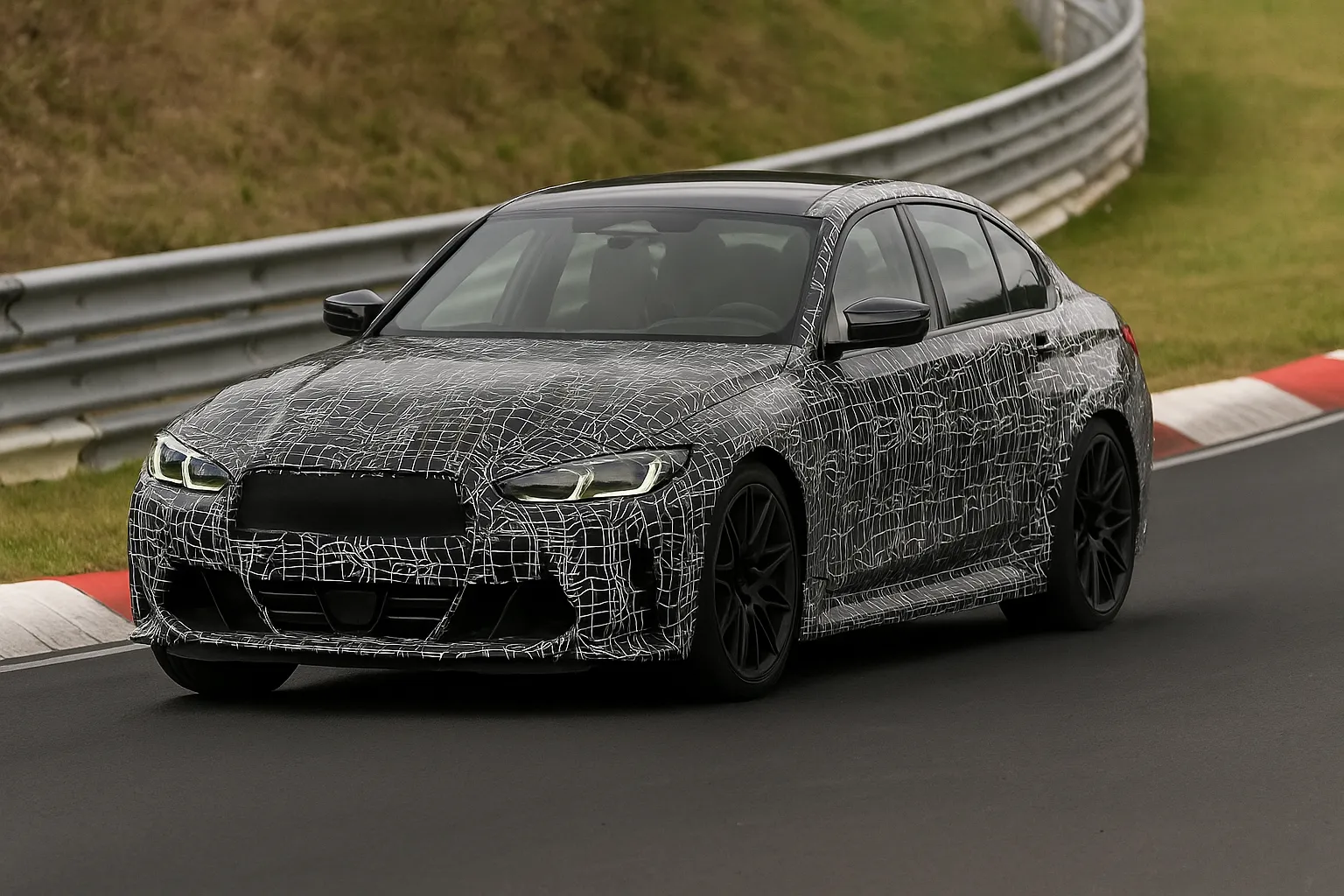
BMW’s electric M future is starting to look less theoretical. A prototype for the first battery-powered BMW M3 has been seen testing at the Nürburgring wearing what appears to be production-intent bodywork, moving the project beyond the early mule stage and giving the clearest indication yet of how BMW plans to translate one of its most important performance names into the EV era.
The biggest takeaway is not simply that an electric M3 is coming. That has been expected as BMW pushes its next-generation Neue Klasse electric architecture toward production. The more important development is that the car appears set to keep the M3 name rather than adopting a separate EV-specific badge. For buyers and enthusiasts, that matters because M3 is not just a trim label. It is one of BMW’s core performance identities, tied to decades of compact sport sedans and coupes built around response, balance, and everyday usability.
A familiar name for a very different M car
BMW’s current EV naming strategy can be confusing. The company already sells electric models with “i” branding, and it also uses M Performance badges on electric vehicles such as the i4 M50 and i7 M70. A full M car is different. The M3 badge has historically signaled a dedicated high-performance model with unique chassis tuning, powertrain development, braking hardware, cooling, and driver-focused calibration.
Keeping the M3 name on the electric model suggests BMW wants continuity rather than a clean break. That is a useful signal to shoppers who may not care whether the performance comes from cylinders or motors, but still expect the car to feel like an M product. It also suggests BMW sees electrification as part of the M3’s future, not a side branch.
At the same time, the electric M3 will inevitably change the formula. Instant torque, regenerative braking, battery placement, software-defined power delivery, and thermal management will replace many of the mechanical traits that define today’s gasoline M cars. The challenge for BMW M will be to make those changes feel deliberate rather than merely inevitable.
Neue Klasse influence is becoming visible
The prototype’s bodywork points toward design influence from BMW’s M Vision Neue Klasse concept. That concept previewed a cleaner, more geometric shape than many recent BMW production models, with short overhangs, a broad stance, and a front-end treatment built around a new interpretation of the brand’s kidney grille.
Even under camouflage, the test car’s proportions are important. A production-body prototype usually means the automaker is evaluating packaging, cooling, aero behavior, chassis setup, and durability with panels and hard points closer to the finished vehicle. It is not final confirmation of every detail, but it is a meaningful step beyond early test mules that may hide new hardware beneath unrelated body shells.
For buyers, that means the electric M3 is no longer just an engineering experiment. It is moving through the visible development process that precedes a showroom model. A 2027 timing has been widely associated with the project, though final launch dates, market rollout, pricing, and specifications remain unconfirmed.
What remains unknown
The most important numbers are still missing. BMW has not released output, battery capacity, range, charging speed, curb weight, motor layout, or performance figures for the electric M3. Those details will determine how it compares with both gasoline M cars and electric rivals.
A high-performance EV sedan can post dramatic acceleration figures relatively easily. The harder task is repeatable performance. Nürburgring testing indicates BMW is working on more than straight-line speed. Track development stresses battery cooling, motor temperatures, brake blending, tire wear, stability control logic, and chassis consistency over long laps.
That matters because M3 owners often expect a car that can commute, cross continents, and tolerate occasional track use. An electric M3 that is quick for one launch but fades under sustained driving would not satisfy the traditional brief. Thermal durability, brake feel, steering precision, and predictable weight transfer will be central to whether the car earns the badge.
Why this matters to shoppers
For performance-car buyers considering their next purchase, the electric M3 creates a new decision point. A gasoline M3 still offers engine character, gear selection, and the familiar rhythm of a combustion performance sedan. An electric M3 would bring immediate response, likely strong traction, quieter operation, lower local emissions, and potentially lower routine maintenance needs.
Ownership questions will shift as well. Instead of oil changes and fuel economy, buyers will focus on home charging, DC fast-charging performance, battery warranty terms, tire costs, brake service, software updates, and real-world range when driven hard. Insurance and depreciation will also be important, especially because high-performance EVs can be expensive to repair if battery or structural components are involved.
The M3 badge could help reduce uncertainty. Established nameplates often give buyers more confidence than unfamiliar EV sub-brands. If BMW can make the electric M3 feel like a true successor rather than a marketing exercise, it may pull longtime M customers into EV ownership more effectively than a completely new model name would.
Why enthusiasts should pay attention
The electric M3 will test what enthusiasts value most in modern performance cars. Some will miss engine sound, manual gearboxes, and the character of a high-revving powertrain. Others will be more interested in precision, response, balance, and lap-time consistency. BMW’s job is to make the latter group feel that something has been gained, not just something lost.
An EV platform also gives engineers new tools. Multiple motors can alter torque distribution faster than traditional mechanical systems. A low-mounted battery can help center of gravity, even if total weight increases. Regenerative braking can be tuned for different driving modes. Software can reshape the car’s behavior more dramatically than in earlier generations.
The risk is that software and power overwhelm feedback. The best M cars are not defined only by acceleration. They communicate. They build confidence. They make the driver feel involved. If BMW can preserve that relationship in an electric sedan, the electric M3 could become a benchmark for the next generation of performance EVs.
A broader industry signal
The move also reflects a larger industry shift. Automakers are no longer limiting EVs to efficiency-focused models or futuristic flagships. They are electrifying their most valuable performance badges because those names carry credibility, pricing power, and loyal audiences.
BMW’s decision to put the M3 identity on an EV, rather than walling it off behind a separate electric sub-brand, may influence how other automakers treat their own heritage models. The message is clear: performance nameplates are expected to survive the transition, but their engineering foundations will change.
For now, the electric M3 remains a developing model with many unanswered questions. The production-style prototype confirms that BMW is deep into the process, and the styling direction appears closely tied to Neue Klasse thinking. The badge strategy may be the most important clue of all. BMW is preparing a radically different M3, but it wants buyers to understand it as an M3 all the same.