Honda Adds Google Gemini AI Assistant to Select Models
Honda is expanding its in-car voice technology with Google Gemini, giving eligible models a more conversational assistant while leaving some vehicles outside the first rollout.

Honda is adding Google Gemini to select vehicles, giving its in-car voice assistant a more conversational brain and pushing the brand deeper into the software-defined-car era.
The update applies to seven of Honda’s popular models, though availability will depend on the specific vehicle, model year, infotainment system, and trim. The important point for shoppers and current owners is that this is not simply another app icon on the screen. Gemini is Google’s newer artificial intelligence assistant, designed to handle more natural prompts than traditional command-based systems.
For drivers, that could make the difference between memorizing a rigid phrase and asking for help in normal language. Instead of tapping through layers of menus or repeating a command until the system understands it, a more advanced assistant can interpret broader requests, follow context more effectively, and potentially combine multiple pieces of information in a single response.
What Gemini changes inside a Honda

Voice control has been part of cars for years, but many systems have felt limited. They often worked best when the driver used exact wording: call a contact, tune a station, set a destination, or adjust a basic function. Newer assistants aim to behave more like a passenger who can understand intent.
In a Honda equipped for the feature, Gemini should make the infotainment experience feel less mechanical. The most obvious use cases are navigation, media selection, messaging, phone calls, and general information requests. Depending on the vehicle’s software integration, voice control may also be able to interact with certain vehicle and cabin features.
That matters because modern dashboards have become increasingly screen-heavy. Even buyers who like large displays do not want to hunt through menus while driving. A better assistant can reduce distraction when it works properly, especially for tasks that would otherwise require taking a hand off the wheel or eyes off the road.
This does not make the vehicle autonomous, and it should not be treated as a substitute for driver attention. Gemini is an infotainment and assistance feature, not a driving system. Its value will depend on how accurately it understands commands, how quickly it responds, and how well Honda and Google limit tasks that are inappropriate while the vehicle is moving.
Why Honda is making the move now
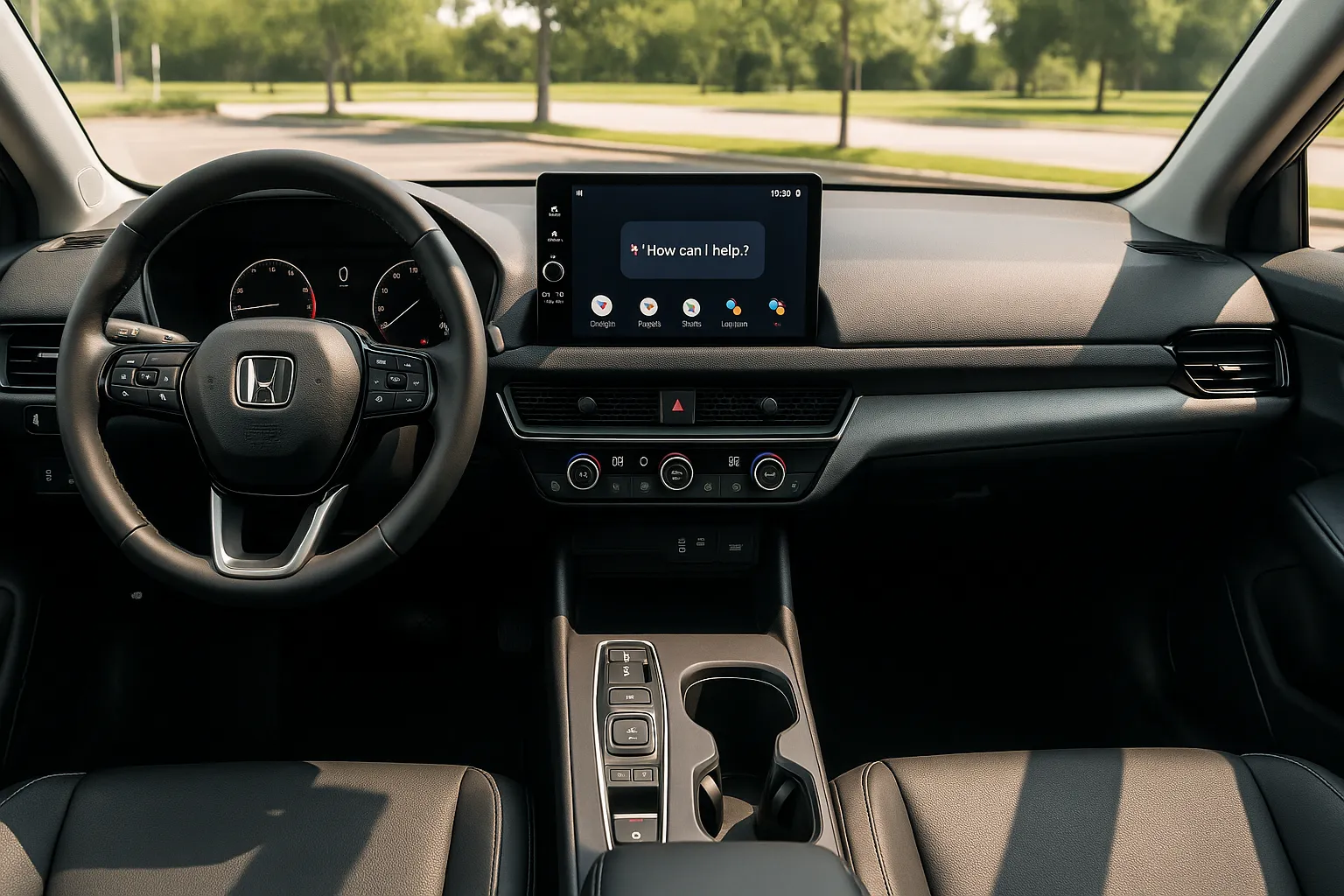
Honda has been steadily modernizing its cabin technology as buyers put more weight on software, connectivity, and screen usability. The days when a good engine, comfortable seats, and strong reliability were enough to define the ownership experience are fading. Those still matter, but shoppers increasingly compare vehicles by phone integration, navigation quality, update capability, app support, and voice control.
Adding Gemini helps Honda keep pace with an industry-wide shift. Automakers are trying to make infotainment systems feel less like fixed hardware and more like evolving platforms. Google, Apple, Amazon, and other technology companies are all competing for space inside the car, while automakers want to preserve their own user experience and brand identity.
Honda’s approach gives it access to a familiar software ecosystem without asking every customer to learn a completely new assistant from scratch. Many buyers already use Google services on their phones or at home. Bringing a version of that experience into the vehicle may reduce the learning curve, particularly for drivers who already rely on voice search, Google Maps, or connected services.
The catch: not every Honda gets it
The rollout is limited. Honda is bringing Gemini to select models, not its entire lineup all at once. That means two shoppers looking at different Hondas on the same dealer lot may not get the same technology experience.
The likely dividing lines are hardware, software architecture, and trim level. Advanced voice assistants need the right infotainment platform, microphones, connectivity features, and processing support. Vehicles with older systems may not be able to support the same experience, even if their touchscreens look similar from the driver’s seat.
For current owners, the key question is whether the feature arrives through a software update or is limited to vehicles built with the required system from the factory. Eligibility should be checked by model year, trim, and vehicle identification number rather than by nameplate alone. A model that offers the feature on one trim may not include it across the entire range.
For shoppers, this makes the test drive more important. It is no longer enough to ask whether a car has a large screen or wireless smartphone projection. Buyers should try the native voice assistant, ask about connected-service requirements, and confirm whether Gemini functionality is included, optional, subscription-based, or dependent on an active data connection.
What buyers should ask at the dealership
Anyone considering a new Honda should ask a few direct questions:
- Is this specific vehicle equipped with Google Gemini capability?
- Is the feature standard on this trim or tied to an option package?
- Does it require an active connected-services plan after a trial period?
- Can the system receive future updates over time?
- Which functions work through Gemini while driving?
- How does it work alongside Apple CarPlay and Android Auto?
That last point matters. Many drivers spend most of their time in Apple CarPlay or Android Auto rather than the factory interface. A better built-in assistant is still useful, but its day-to-day value depends on whether it can coexist smoothly with the phone-based system a driver already prefers.
A bigger signal for the industry
Honda’s Gemini rollout is part of a broader movement toward AI-enhanced vehicle interfaces. Automakers are not just adding larger screens; they are trying to make cars better at understanding the people inside them. The goal is a cabin that can respond naturally to requests, surface useful information, and reduce friction during routine tasks.
There is also a competitive angle. Buyers may not choose a vehicle solely because it has a smarter assistant, but clunky infotainment can absolutely hurt a vehicle’s appeal. A strong voice system can make a car feel newer for longer, while a weak one can make even an otherwise excellent vehicle feel dated.
For Honda, the benefit is clear: Gemini gives select models a more modern tech story without changing their underlying mechanical formula. For owners, the benefit is practical if the assistant saves time and reduces screen interaction. For shoppers, the message is just as practical: check the exact vehicle, not just the badge.
Honda’s reputation has long been built on durability, efficiency, and everyday usability. With Gemini, the company is trying to extend that usability into the digital side of the car. The success of the rollout will depend less on the AI branding and more on whether the system works reliably in the moments drivers actually need it.