Ferrari 12Cilindri Manuale Revives the Gated Shifter—By Wire
Ferrari’s limited-run 12Cilindri Manuale brings back a clutch pedal and open-gate shifter, but the hardware underneath remains an eight-speed dual-clutch transmission.
Ferrari has found a new way to answer an old enthusiast request. The limited-run 12Cilindri Manuale brings a clutch pedal and an open-gate shifter back to a modern front-engine V12 Ferrari, but it does not mark a simple return to a conventional mechanical manual gearbox.
Instead, the new variant uses Ferrari’s eight-speed dual-clutch transmission as its foundation and overlays it with a by-wire manual interface. The driver gets a six-speed metal gate between the seats and a third pedal in the footwell. The gearbox, however, is still an electronically controlled dual-clutch unit mounted at the rear axle, as in the standard 12Cilindri.
That distinction matters. This is not a retro conversion aimed at recreating a 550 Maranello or 575M in every mechanical detail. It is a modern supercar experiment that tries to combine manual-like driver interaction with the speed, packaging, emissions compatibility, and reliability advantages of an automated transmission.
A manual, but not in the traditional sense
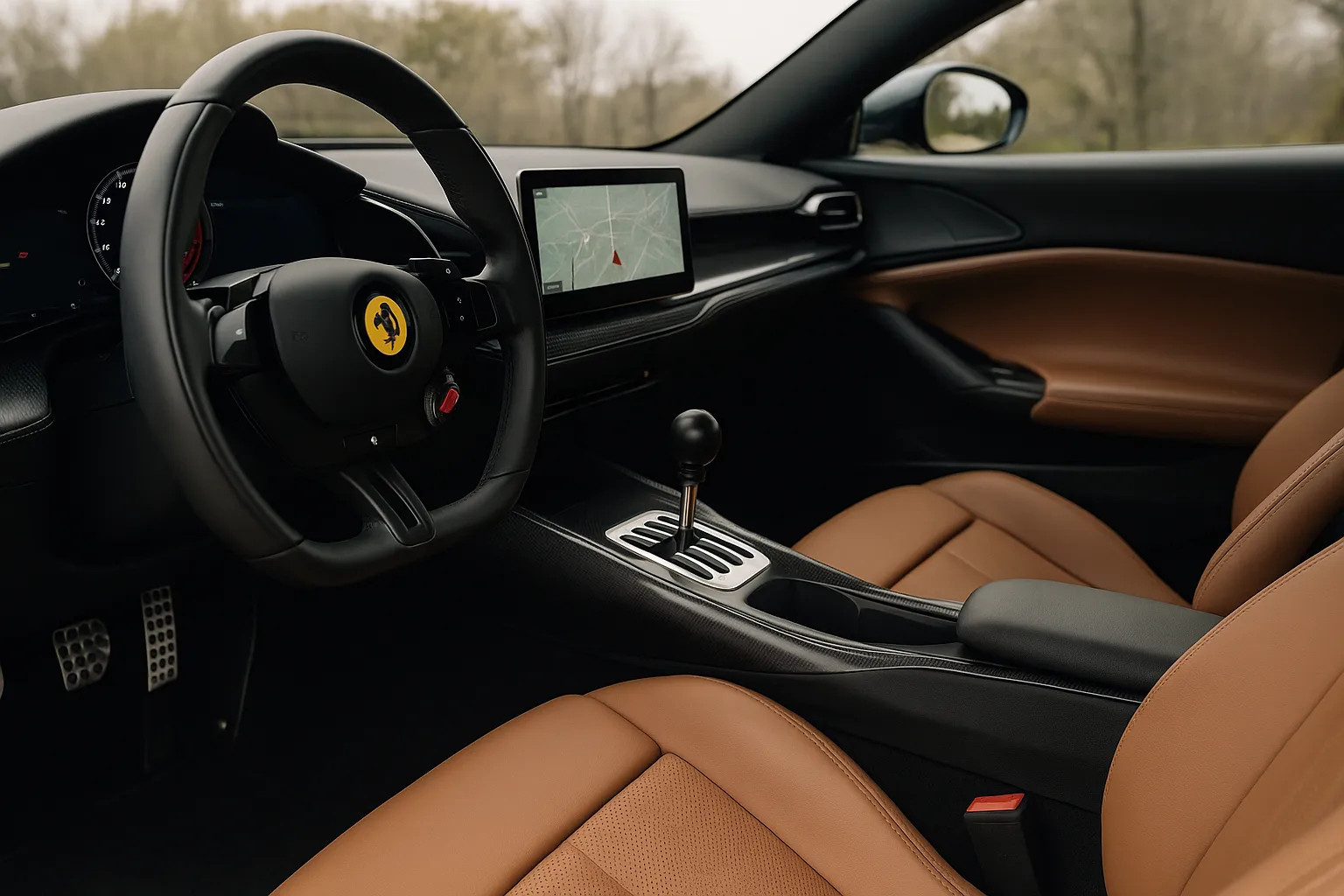
The 12Cilindri Manuale’s system is best understood as a manual-style control layer for a dual-clutch gearbox. Ferrari calls the technology Manuale By-Wire. The gear lever and clutch pedal are not physically connected to the transmission or clutch in the way they would be in an older manual Ferrari. Their movements are converted into electronic commands, which the car then uses to control the existing dual-clutch hardware.
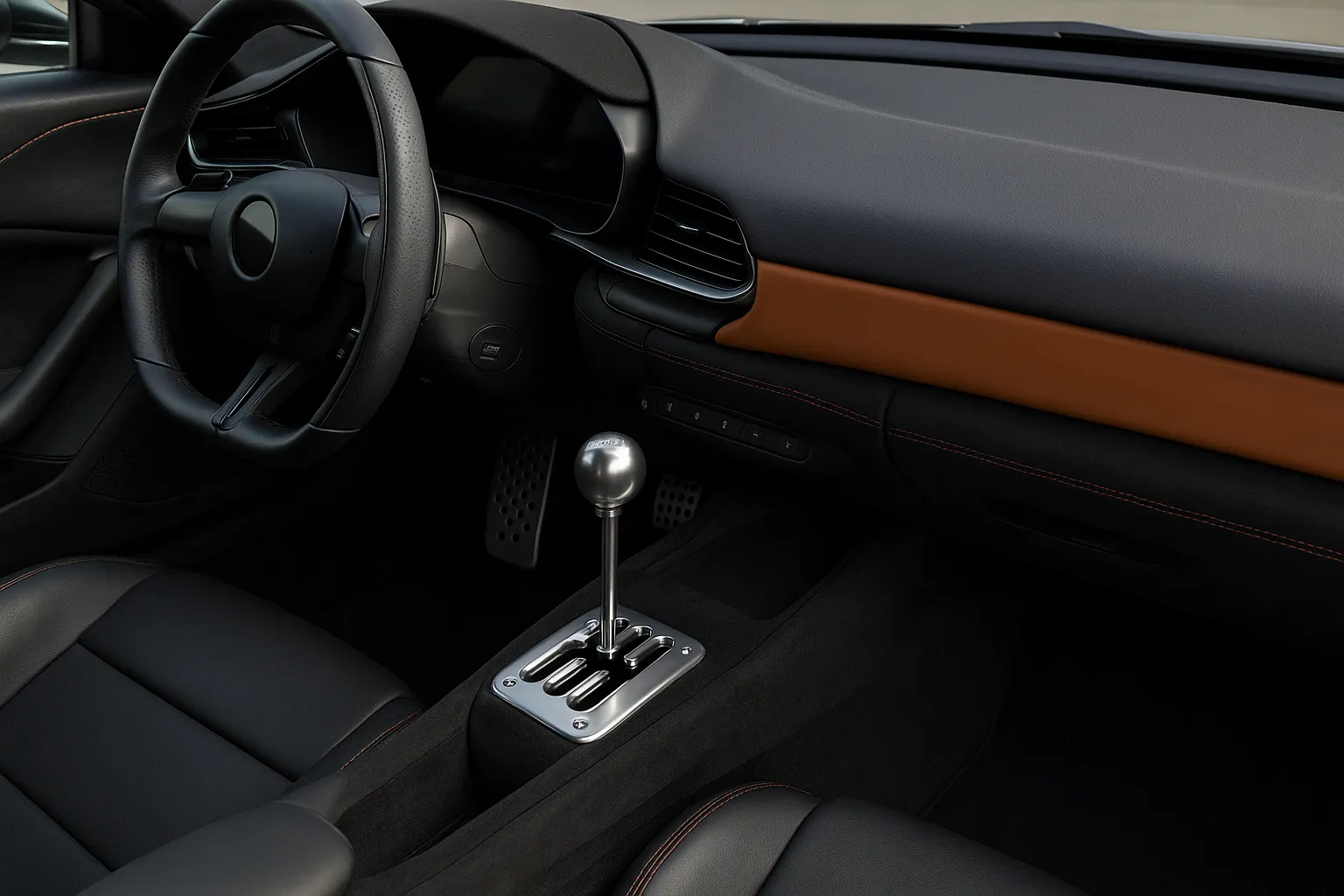
Inside, the most visible change is the shifter itself. It sits in a metal module with an exposed six-speed gate, giving the driver the familiar pattern and mechanical theatre long associated with classic Ferraris. A clutch pedal is also fitted, allowing the driver to initiate shifts with a familiar left-foot action.
The system can still operate like a regular automatic. On startup, the car defaults to its standard drive-by-button arrangement, with reverse, neutral, and drive selected from the center console. Depressing the clutch pedal activates the manual mode, with the illuminated gate signaling that the car is ready for driver-selected shifts.
Ferrari has not fully detailed every calibration choice, including how the six physical gate positions correspond with the eight available ratios in the dual-clutch transmission. What is clear is that the company is not replacing the DCT with a traditional six-speed gearbox. The new controls are designed to create a tactile experience while preserving the performance envelope of the modern transmission.
The V12 remains the centerpiece
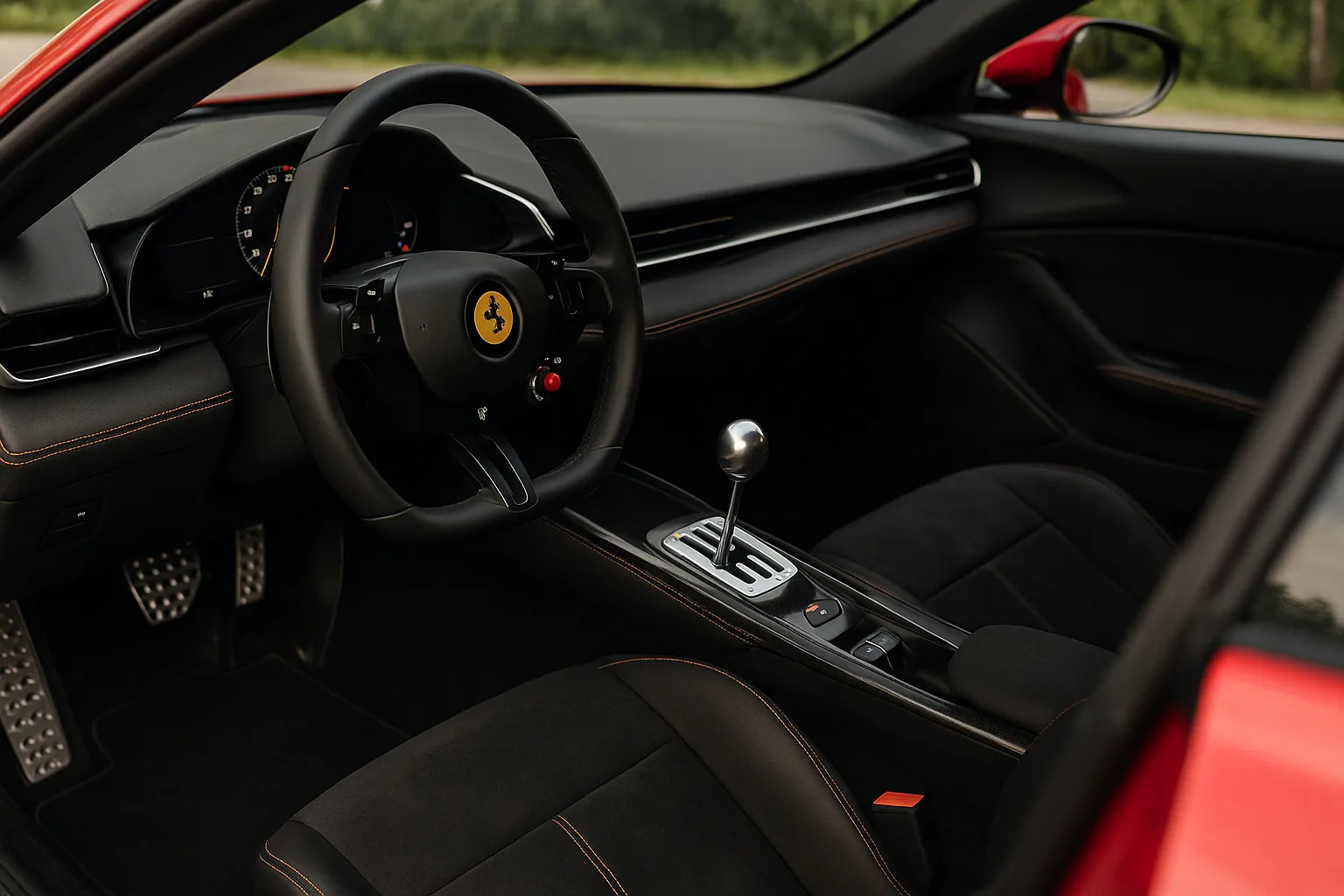
The Manuale is based on the Ferrari 12Cilindri, the brand’s front-engine grand-touring supercar powered by a naturally aspirated 6.5-liter V12. In the standard model, that engine produces 819 hp and revs to 9,500 rpm, making it one of the clearest links between Ferrari’s current road cars and its naturally aspirated past.
That engine choice is important because the emotional argument for a manual Ferrari has always been strongest in the V12 cars. Modern turbocharging, hybrid assistance, and ultra-fast automated gearboxes have improved performance dramatically, but many enthusiasts still associate Ferrari’s identity with a high-revving naturally aspirated engine and a driver-operated gear lever.
The 12Cilindri Manuale does not restore that recipe exactly, but it does put the driver’s hands and feet back into the shifting process. For some buyers, that may be enough. For others, the absence of a direct mechanical connection will be the defining limitation.
Limited production through Tailor Made
Ferrari plans to build the 12Cilindri Manuale as a limited edition through its Tailor Made personalization program. The planned run is 1,499 units, making it rare by mainstream standards but relatively substantial for a special Ferrari configuration.
Pricing, market allocation, and delivery timing have not been fully detailed. Given the 12Cilindri’s position in Ferrari’s lineup and the added exclusivity of the Manuale specification, it is reasonable to expect a significant premium over the regular car. Buyers will also likely have broad access to bespoke trim, materials, colors, and interior finishes through Tailor Made.
For collectors, the production number will be a key part of the car’s appeal. Manual Ferraris from the late 2000s and early 2010s have become especially valuable because they arrived at the end of the brand’s true three-pedal era. The Manuale introduces a different proposition: not the last of the old manuals, but perhaps the first of a new category of electronically simulated manual supercars.
Why Ferrari is doing this now
The timing is not accidental. Demand for driver involvement has become a premium feature in the high-end market. Porsche has kept manual gearboxes alive in selected 911 variants, while several boutique manufacturers have leaned heavily into tactile controls as a point of differentiation. At the same time, the engineering case for traditional manuals has weakened in very high-performance cars.
Dual-clutch and automated gearboxes shift faster, integrate more easily with stability systems, and are better suited to hybridization and emissions testing. They also help manufacturers manage torque delivery, launch performance, and durability. For a company like Ferrari, which must balance lap-time capability, refinement, regulations, and customer expectations across global markets, a pure manual gearbox is no longer the obvious solution.
A by-wire manual interface offers a compromise. It can give owners a more involving ritual without forcing Ferrari to engineer a fully mechanical transmission for a low-volume application. It may also allow the car to protect itself from damaging shift inputs in ways an old manual could not.
That protection will be a selling point for some owners and a drawback for others. A real manual rewards skill partly because it allows mistakes. A by-wire system can be tuned to simulate resistance, timing, and engagement, but it cannot be identical to a linkage, clutch disc, pressure plate, and gearset directly controlled by the driver.
What it means for buyers and enthusiasts
For the small group of customers able to buy one, the 12Cilindri Manuale offers a rare combination: a naturally aspirated V12 Ferrari with a driver-operated shift interface in an era dominated by paddles. It should be more engaging than the standard car in everyday and back-road driving, even if it is not a purist manual in the traditional sense.
For enthusiasts watching from the outside, the car is arguably more important as a signal than as a product. Ferrari is acknowledging that physical controls and shifting involvement still have value, even at the top end of the market. The company is also showing how future performance cars might preserve some analog character while using digital control systems underneath.
The 12Cilindri Manuale will not settle the debate over simulated manuals. Some drivers will see it as a clever bridge between eras; others will view it as a substitute for a mechanical experience that has been lost. Either way, it is a significant development because Ferrari is not merely adding nostalgia-themed trim. It is redesigning the way a modern dual-clutch supercar can be driven.
In that sense, the Manuale is less a return to the past than a test of what the next generation of enthusiast interfaces might look like. The clutch pedal is back. The gated shifter is back. The mechanical manual gearbox, at least here, is not.