Petrol BMW M3 Prototype Shows the Next M Car Won’t Be EV-Only
A camouflaged next-generation BMW M3 has been seen testing with straight-six power, quad exhausts and Neue Klasse-inspired styling, confirming that the electric M3 will not stand alone.
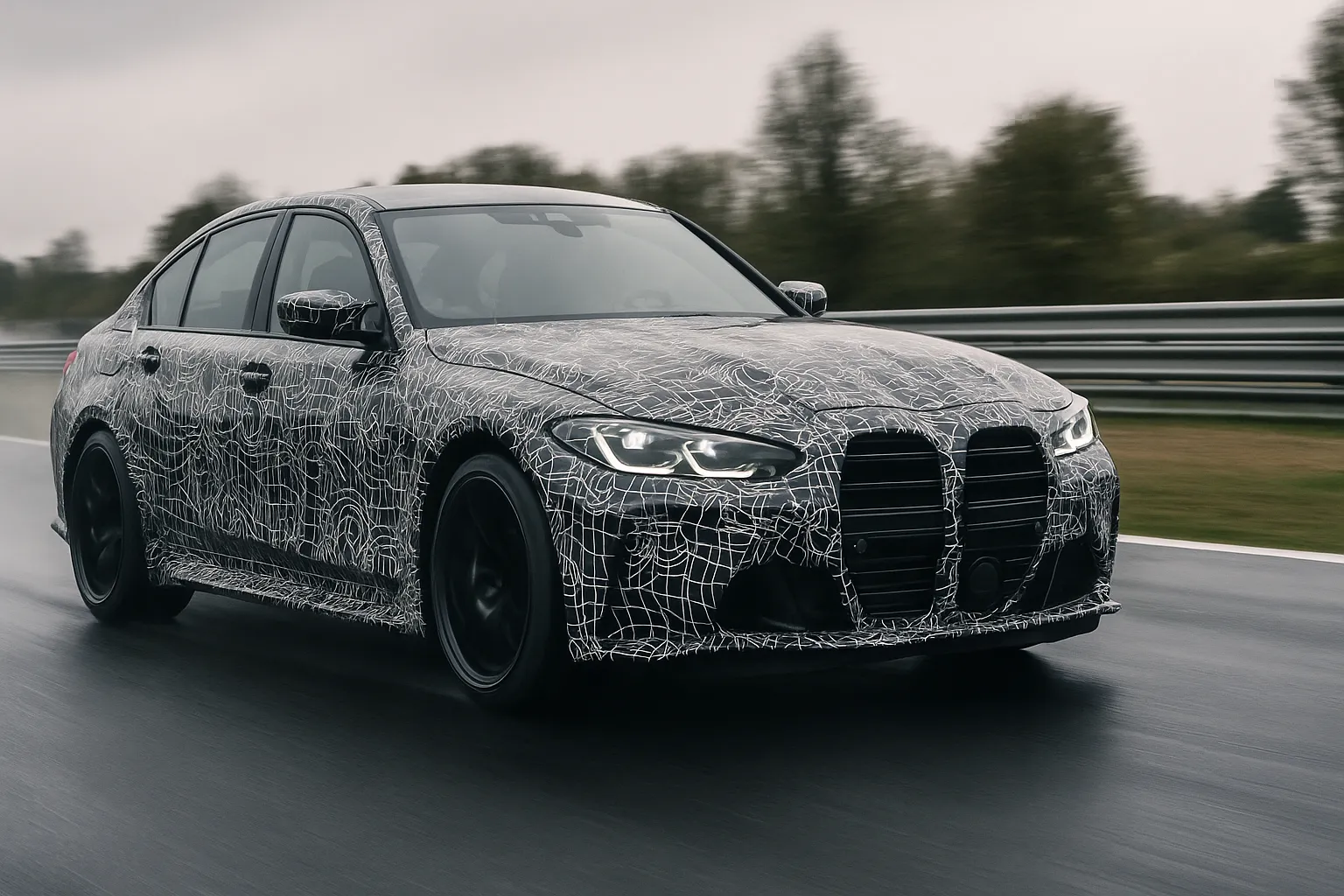
BMW’s next M3 is beginning to take shape, and the latest prototype suggests the famous performance saloon will enter its next generation with two very different powertrain paths. A camouflaged combustion-powered M3 has been seen testing on road and at the Nürburgring, showing that BMW M is not ready to turn one of its best-known nameplates into an electric-only model.
The key detail is not subtle: this prototype carries the familiar visual clues of a petrol M car. The test vehicle has extra front-end cooling, large performance brakes, wide wheelarches and, most importantly, four exhaust outlets at the rear. That combination points to a combustion engine rather than a plug-in hybrid or battery-electric setup. The next M3 is expected to retain a straight-six engine, preserving the layout that has defined modern versions of the car.
At the same time, BMW is also preparing an electric M3. That means the next-generation M3 family should give buyers a choice the model has never offered before: a traditional petrol high-performance saloon or a fully electric version wearing the same core badge.
A familiar engine in a very different-looking M3
The petrol prototype shows clear links to BMW’s new design direction. The company’s latest performance and electric concepts have moved toward a more squared-off, cleaner shape, with a broad front graphic that blends the kidney grille area into the lighting signature. The M3 prototype appears to follow that approach, although camouflage still hides the production details.
Even under disguise, the proportions look more upright and block-like than the current M3. The front end appears to share themes with BMW’s incoming Neue Klasse-inspired models, including a flatter nose treatment and slim lighting elements integrated with dark grille sections. Lower down, the petrol car appears to use additional openings for cooling, a practical difference from the electric M3 prototypes and concept previews.
The side profile is where the M division’s changes are easier to read. The car sits wide, with swollen arches and large wheels filling the bodywork. The brake hardware also looks suitably serious, which matters for a car expected to spend time on track as well as on fast roads. At the rear, the quad-exhaust layout remains one of the clearest signs that BMW intends to keep the combustion M3 visually and mechanically distinct from the electric model.
Petrol and electric M3s will have to share a badge
The most significant shift is not just the survival of the petrol car, but the existence of two M3s with different identities. For decades, the M3 has evolved through four-cylinder, six-cylinder and V8 phases before returning to turbocharged six-cylinder power. The next generation is set to add a new chapter by splitting the formula between combustion and electric performance.
That creates an unusual challenge for BMW. The electric M3 will need to justify the badge with the instant response, high output and chassis control expected from a modern EV performance saloon. The petrol M3, meanwhile, must satisfy drivers who still value engine character, sound, gearshift behavior and lighter long-distance usability. The two cars may look related, but they are likely to appeal to different buyers.
Final specifications remain unconfirmed. BMW has not detailed power outputs, drivetrain layouts, transmission choices, battery capacity for the EV, or whether all markets will receive the same versions. The current M3 is sold in different forms depending on market and specification, including rear-wheel-drive and all-wheel-drive variants in some regions, so a similar level of complexity would not be surprising.
Why this matters to buyers
For buyers, the next M3 could become one of the clearest examples of the industry’s transition period. Rather than forcing one technology choice, BMW appears to be preparing a dual strategy. That matters for shoppers who want high performance but are not ready to move to a full EV, whether because of charging access, driving patterns, track-day use or simple preference.
A petrol M3 with straight-six power would also protect residual appeal among enthusiasts. Previous M3 generations have become desirable partly because each engine layout represents a distinct era. If the next petrol M3 arrives alongside an electric model, it may be viewed as one of the final combustion chapters in the M3 story, even if BMW has not put an end date on petrol M cars.
For EV-minded buyers, the electric M3 could offer a different kind of performance advantage. Electric motors can deliver rapid torque response and advanced torque distribution, giving engineers new tools for acceleration and cornering behavior. The challenge will be weight, heat management and steering feel — areas where traditional M3 buyers tend to be especially demanding.
What it means for BMW M
The decision to develop both versions shows how carefully BMW is managing its performance brand. M cars need to satisfy regulation, global market demands and changing buyer expectations without losing the emotional qualities that made them popular. A fully electric M3 gives BMW a future-facing flagship. A petrol M3 keeps continuity with the customers who built the car’s reputation.
The Nürburgring testing also signals that BMW is benchmarking the combustion car in a familiar way. The circuit’s mix of high-speed sections, compressions, braking zones and uneven surfaces remains useful for developing suspension, cooling and durability. For a car as scrutinized as the M3, lap-time bragging rights are only part of the story; repeatable performance and driver confidence are just as important.
A cautious but important preview
There is still plenty we do not know. The camouflage hides the final styling, and no official figures for power, weight, performance or launch timing are available from the details seen so far. It is also unclear how closely the petrol and electric M3s will be aligned in price, equipment and market availability.
Even so, the message from this prototype is clear enough: the next BMW M3 will not be defined by a single powertrain. The electric version will push the badge into a new era, while the petrol model appears set to keep the straight-six tradition alive. For enthusiasts and buyers weighing their next performance saloon, that choice may be the most important feature of all.